Complete Dave the Diver Jungle Expansion All Fish, Predators, Bosses and Wildlife Found in Utara Lake
Whether you're trying to complete the new story content, maximize restaurant profits, photograph rare wildlife, or hunt legendary creatures lurking beneath the surface, knowing what lives inside Utara Lake is essential.
Highlights
What the In the Jungle DLC Adds
- A completely new freshwater ecosystem
- The explorable region of Utara Lake
- Mangrove forests and ancient ruins
- New fish and aquatic species
- Multiple crocodilian predators
- Legendary boss encounters
- Wildlife photography opportunities
- Bancho Grill restaurant mechanics
- Smoking and grilling-focused cooking
- Approximately 10 hours of additional story content
- New weapons including the versatile Jungle Gun
Exploring the New Ecosystem of Utara Lake
Moving from the vast open ocean of the Blue Hole to the enclosed waters of Utara Lake changes the experience dramatically.
The lake environment feels more dangerous and unpredictable. Visibility can disappear within seconds. Thick mangrove roots create narrow pathways that restrict movement. Strong underwater currents can push Dave directly into hazards, while hidden predators often wait behind vegetation and submerged structures.
Unlike many creatures from previous regions, numerous species in Utara Lake don't flee when threatened. Instead, they become aggressive and actively pursue the player.
As a result, preparation becomes more important than ever.
Understanding the behavior of every species before entering the water can make the difference between a profitable dive and an emergency oxygen shortage.
Dave the Diver Jungle DLC Fish List
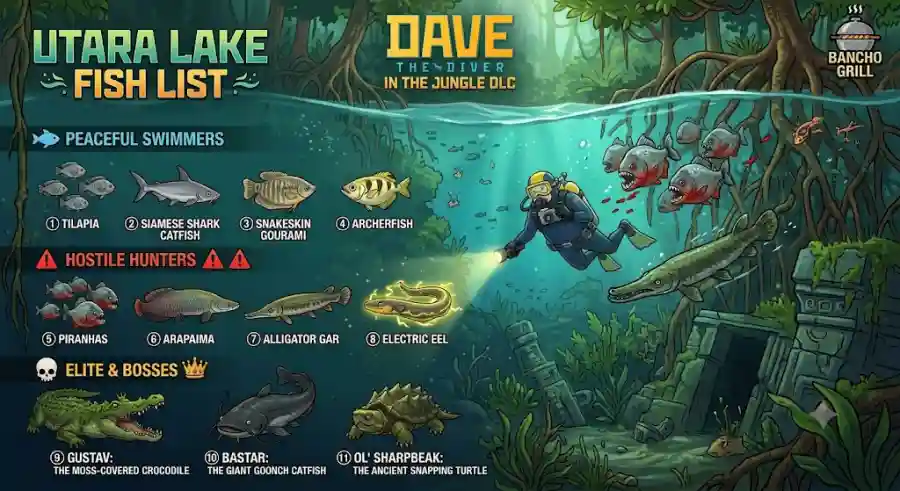
Peaceful Fish and Easy Early-Game Catches
For players beginning their journey through Utara Lake, several freshwater species provide reliable resources without posing significant danger.
These fish are ideal for gathering ingredients, completing requests, and building up Bancho Grill's menu options.
Tilapia
Tilapia serves as one of the most common freshwater fish in the DLC.
Often found swimming in schools near mangrove roots and shallow water zones, they are among the easiest catches available. A standard harpoon is usually enough to secure them quickly.
Because of their abundance, Tilapia becomes an important resource during the early stages of progression.
Siamese Shark Catfish (Swai)
Despite the intimidating name, the Siamese Shark Catfish—commonly known as Swai—is surprisingly peaceful.
These large fish tend to roam the lake's mid-depth areas and rarely display aggressive behavior toward Dave.
Their larger size makes them particularly valuable because they provide substantial meat yields that can be used for Bancho Grill's growing menu.
Snakeskin Gourami
One of the most visually distinctive species in Utara Lake is the Snakeskin Gourami.
Their patterned scales make them easy to recognize, and they typically remain close to the surface.
Using a Net Gun allows players to consistently obtain high-quality 3-star catches, making them especially valuable for cooking and special requests.
Archerfish
Archerfish are famous for their real-world ability to shoot water droplets at prey above the water's surface.
In the DLC, however, they are relatively passive creatures that move slowly and predictably.
Their calm behavior makes them easy targets for efficient harvesting.
Clown Knife Fish
Players exploring Utara Lake after sunset will eventually encounter the Clown Knife Fish.
This sleek nocturnal species becomes more active during nighttime dives and is highly sought after due to the quality of meat it provides.
Many high-level villager requests benefit from this valuable catch.
Whisker Sheatfish
The Whisker Sheatfish prefers staying near muddy lake bottoms.
As a passive bottom-feeding species, it presents little threat to divers. However, its larger body size means transporting it can consume significant cargo space.
Players focused on efficient inventory management should keep this in mind.
The Hostile Hunters of Utara Lake
Dangerous Predators That Can Drain Your Oxygen Fast
As players descend deeper into the lake, the peaceful atmosphere quickly disappears.
Aggressive predators become increasingly common, and many of them can deplete oxygen reserves at an alarming rate.
Some of these encounters rival—or even surpass—the intensity of threats found in the original Blue Hole.
Piranhas: The Schooling Terror
Piranhas are among the first major dangers players encounter.
At first glance, they may seem small and manageable. That assumption usually doesn't last long.
These predators operate in groups and attack relentlessly.
Spotting a single piranha often means several more are nearby, ready to swarm unsuspecting divers.
Their durability is surprisingly high relative to their size, making basic knives and entry-level harpoons less effective than expected.
Recommended Strategy
- Use the Jungle Gun's spread-shot mode
- Deploy explosive grenade launchers
- Eliminate entire groups before they surround Dave
- Avoid getting trapped in narrow mangrove corridors
Arapaima and Alligator Gar: The Heavy Hitters
Arapaima
The Arapaima initially appears calm and harmless.
However, once provoked—or if a harpoon attack misses—it can launch forward with startling speed.
Its armored body and powerful charge attacks make it one of the more intimidating non-boss creatures in the expansion.
Alligator Gar
The Alligator Gar frequently patrols areas surrounding submerged ruins.
Its heavily armored snout allows it to deliver devastating attacks that can quickly punish careless players.
Best Capture Methods
For players aiming to preserve maximum quality and secure valuable 3-star catches, the following equipment is recommended:
- Steel Net Trap
- Fully upgraded Tranquilizer Gun
Electric Eels: The Shock Specialists
Veterans of the Blue Hole may remember the frustration caused by the Marbled Electric Ray.
The Electric Eel introduces a similar challenge to the jungle environment.
These predators move erratically and unpredictably, making them difficult to target.
Their most dangerous ability is a localized electrical shockwave capable of slowing Dave dramatically.
When stunned, players become vulnerable to attacks from nearby predators, often leading to chain reactions that rapidly drain oxygen supplies.
Careful positioning is essential when engaging Electric Eels.
The Apex Crocodilians
The Most Fearsome Predators in the Jungle
One of the biggest surprises in the DLC is the introduction of crocodilian predators.
Unlike fish, these reptilian hunters bring entirely new attack patterns and combat challenges.
Several variants patrol specific depth zones throughout Utara Lake.
Caiman
The Caiman represents the smallest crocodilian threat.
Fast and agile, it behaves somewhat similarly to the Sawfish encountered in previous content.
Despite its size, it should not be underestimated.
Gator
The Gator occupies the middle tier of crocodilian threats.
Extremely aggressive, it often uses underwater vegetation and jungle foliage to conceal its approach before launching sudden ambush attacks.
Players frequently find themselves attacked from behind when exploring dense sections of the lake.
Nile Crocodile
The Nile Crocodile stands as one of the most dangerous standard enemies in the DLC.
Its health pool rivals some of the toughest predators from the base game, including the Porbeagle Shark.
Combined with an enormous bite radius and relentless aggression, it becomes a true test of preparation and combat skill.
Elite Bosses and Legendary Targets
The Ultimate Challenges of Utara Lake
Progressing through the DLC's roughly 10-hour story expansion eventually brings players face-to-face with legendary creatures that dominate the local ecosystem.
These encounters require strategy, patience, and precise execution.
Gustav: The Moss-Covered Crocodile
Gustav serves as one of the central threats affecting the local village.
For years, this massive crocodile has terrorized the surrounding area, earning a fearsome reputation among residents.
What makes Gustav particularly dangerous is the thick layer of reeds, vegetation, and moss covering his body.
These natural defenses significantly reduce the effectiveness of standard piercing ammunition.
How to Defeat Gustav
Players must:
- Use environmental hazards strategically
- Avoid sweeping tail attacks
- Stay mobile throughout the encounter
- Target the vulnerable underbelly whenever openings appear
This battle represents one of the most memorable boss fights in the expansion.
Bastar: The Giant Goonch Catfish
Deep within the darkest cave systems of Utara Lake lurks Bastar.
This enormous Goonch Catfish uses the lake's murky conditions to its advantage, effectively disappearing into the shadows before launching devastating surprise attacks.
One of its signature moves involves powerful spinning assaults capable of catching players completely off guard.
Survival Tips
- Upgrade your flashlight before attempting the fight
- Maintain visibility whenever possible
- Watch for movement patterns in dark water
- Avoid staying stationary for extended periods
Without proper preparation, Bastar can quickly overwhelm even experienced players.
Ol' Sharpbeak: The Ancient Alligator Snapping Turtle
Few creatures in the DLC are as intimidating as Ol' Sharpbeak.
This ancient Alligator Snapping Turtle functions almost like a living fortress.
Its shell is virtually impenetrable, preventing players from relying on conventional damage strategies.
Boss Strategy
To win this encounter, players must:
- Bait Ol' Sharpbeak into attacking
- Dodge the snapping bite at the last possible moment
- Wait for the recovery animation
- Strike the exposed neck before retreating
Patience and timing are absolutely critical.
Wildlife Photography Returns
Camera Creatures and Passive Encounters
Not every animal encountered in the jungle is destined for Bancho Grill.
The DLC also expands on the popular photography mechanics, encouraging players to document wildlife rather than harvest it.
These peaceful encounters provide valuable rewards and offer a welcome break from combat-heavy dives.
Capybara
The Capybara quickly steals the spotlight as one of the most charming animals in the expansion.
Often found relaxing near shorelines and riverbanks, these laid-back creatures are beloved by villagers.
Capturing photographs of them while bathing can earn substantial rewards.
Pygmy Hippopotamus
Small, adorable, and surprisingly quick, the Pygmy Hippopotamus occasionally ventures into shallow waters.
Photographing these elusive mammals adds another layer of exploration to the DLC experience.
Pink River Dolphin
One of the most beautiful wildlife encounters in Utara Lake is the Pink River Dolphin.
These rare creatures occasionally leap near mangrove canopies, creating perfect opportunities for memorable photographs.
The species also serves as a nostalgic callback to the dolphin rescue activities featured in the original game.
How to Maximize Your Catch in Utara Lake
Essential Strategies for Success
The tactics that worked in the Blue Hole don't always translate to the jungle.
Players who adapt quickly will find themselves earning significantly more rewards.
Focus on Grilling Instead of Sushi
One of the biggest gameplay changes involves food preparation.
Freshwater fish can carry parasites, which means Bancho refuses to serve them raw.
As a result, the traditional sushi-focused business model takes a back seat.
Instead, players should prioritize:
- Smoking techniques
- Grilling upgrades
- New Bancho Grill recipes
- High-value cooked dishes
Craft the Jungle Gun Early
The Jungle Gun is one of the most important additions in the DLC.
Its ability to switch firing modes during dives makes it exceptionally versatile.
Players can seamlessly alternate between:
- Wide-spread nets for piranha schools
- Precision shots for larger targets
- High-damage slugs for crocodilian encounters
This flexibility makes the weapon invaluable throughout the expansion.
Pay Attention to Mud and Visibility
Utara Lake introduces a dynamic visibility system.
Swimming too close to muddy riverbeds can stir up thick clouds of sediment.
These mud clouds dramatically reduce visibility, making it difficult to spot approaching threats.
In some situations, predators can remain completely hidden until they are already attacking.
Maintaining awareness of the environment becomes just as important as monitoring oxygen levels.
Industry Impact
The release of Dave the Diver: In the Jungle demonstrates how successful expansions can reinvent gameplay without abandoning a game's core identity.
Rather than simply introducing new fish into existing locations, MINTROCKET built an entirely fresh ecosystem complete with new mechanics, wildlife behaviors, environmental hazards, boss encounters, and restaurant systems.
This approach keeps long-time players engaged while giving newcomers an exciting reason to jump into the adventure.
For a title already praised for blending exploration, management simulation, and action gameplay, the jungle expansion represents a substantial evolution.
Why the In the Jungle DLC Matters
The DLC succeeds because it changes more than the scenery.
Players must learn new hunting techniques, adjust restaurant strategies, manage visibility challenges, and adapt to entirely different predator behaviors.
The introduction of crocodilians, legendary bosses, freshwater cooking systems, and wildlife photography ensures the experience feels genuinely new rather than a simple extension of existing content.
It expands the world of Dave the Diver in meaningful ways while preserving the charm that made the original game so popular.