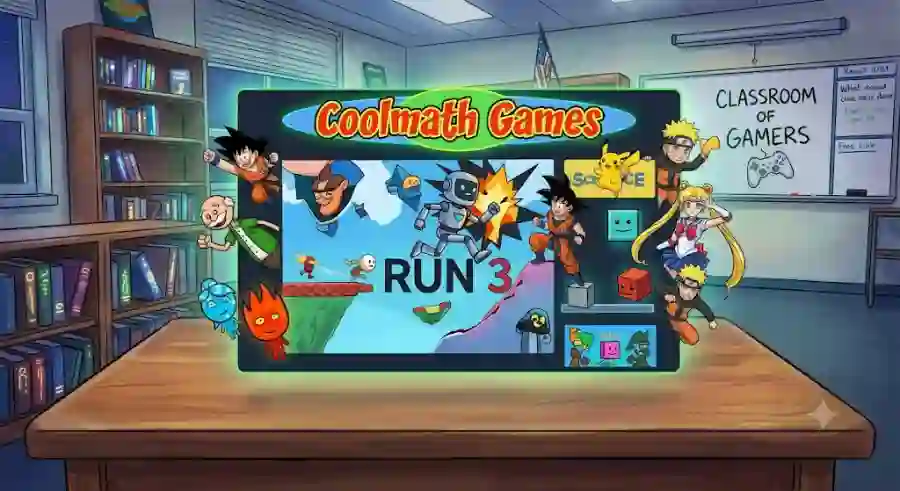
From School Computer Labs to Modern Browsers: How Coolmath Games Survived Flash, Trends and the Rise of Console Gaming
For many students, Coolmath Games was the ultimate digital escape. The name itself was its greatest disguise. Because the word “math” appeared clearly in the website address, strict school internet filters often allowed access. Teachers believed students were practicing logic or improving mathematical skills. In reality, many players were managing restaurants in Papa’s Pizzeria, solving impossible puzzles, or desperately trying to guide a tiny red square through dangerous obstacles.
Highlights: Why Coolmath Games Became a Browser Gaming Icon
- Built a massive audience through simple but addictive browser games
- Turned “educational gaming” into entertaining problem-solving experiences
- Created legendary titles like Papa’s Pizzeria, Run, Bloxorz, and The World’s Hardest Game
- Successfully survived the end of Adobe Flash technology
- Converted classic games into modern HTML5 and JavaScript formats
- Maintained popularity without expensive hardware, subscriptions, or complicated systems
The Great Educational Illusion: Was Coolmath Games Really About Math?
Let’s be honest: most players visiting Coolmath Games were not trying to improve their algebra skills.
Very few students opened the website hoping to memorize formulas or practice multiplication tables.
That was never the real magic behind the platform.
Coolmath Games completely changed the meaning of “math” by focusing on the skills hidden behind problem-solving. Instead of traditional classroom exercises, the website introduced players to logic, planning, strategy, timing, and creativity through interactive challenges.
The genius idea was simple:
Make people think without making them feel like they were studying.
The games did not look like lessons. They felt like entertainment. Players were not completing homework assignments; they were overcoming challenges, improving their skills, and chasing the satisfaction of finally beating a difficult level.
That approach helped Coolmath Games become one of the most successful examples of casual educational gaming.
Problem-Solving Hidden Inside Entertainment
Many of the platform’s biggest hits quietly trained players’ brains while keeping them completely engaged.
Run 3: A Lesson in Space, Movement, and Reaction
At first glance, Run 3 looks like a simple endless runner. The player controls a small character moving through a futuristic space tunnel.
However, the real challenge goes much deeper.
The game constantly changes the player’s understanding of movement. Walls become floors, gravity shifts unexpectedly, and every decision requires quick thinking.
Players were not calculating scientific formulas, but they were developing spatial awareness and reaction skills. The game encouraged people to understand movement patterns and adapt instantly.
That combination of simplicity and challenge made Run 3 one of the most recognizable browser games of its generation.
Fireboy and Watergirl: Teamwork Through Puzzle Design
Another legendary Coolmath Games experience was Fireboy and Watergirl.
The concept was simple: control two different characters with opposite abilities and work together to complete puzzle-filled levels.
Fireboy and Watergirl required players to coordinate movements, understand timing, and sometimes even cooperate with another person sitting beside them.
For many students, it became a multiplayer experience before online gaming became the dominant trend.
The game proved that a simple keyboard-based puzzle could create teamwork, communication, and problem-solving moments.
Bloxorz: A Masterclass in Spatial Thinking
Few games represented Coolmath Games’ philosophy better than Bloxorz.
The objective sounded easy: move a rectangular block into a square hole.
But the challenge quickly became complicated.
Players had to rotate the block carefully, understand positioning, predict movements, and avoid falling from the platform. What appeared to be a simple puzzle became a serious test of spatial awareness and logical thinking.
Bloxorz showed that a game did not need advanced graphics or complex mechanics to become memorable. A smart idea and carefully designed challenges were enough.
The Holy Trinity of Coolmath Games Hits
Although Coolmath Games hosted thousands of titles over the years, a few games became cultural icons among students everywhere.
These were the games people immediately searched for whenever they reached a school computer.
1. The Legendary Papa Louie Franchise
Few browser games created the same level of obsession as the Papa Louie series.
Whether players were running a pizza shop in Papa’s Pizzeria, managing frozen treats in Papa’s Freezeria, or building burgers in Papa’s Burgeria, the formula remained incredibly addictive.
The gameplay looked simple:
- Take customer orders
- Prepare food correctly
- Manage cooking times
- Add toppings accurately
- Receive ratings from customers
But behind the colorful design was a surprisingly deep management system.
Players had to multitask under pressure, remember multiple orders, and constantly improve their performance.
For many young gamers, these games introduced concepts like organization, time management, and efficiency long before they encountered them in real-world situations.
The virtual restaurant may have been fictional, but the pressure felt very real.
2. The World’s Hardest Game: A True Test of Patience
The name was bold, but it was not exaggerated.
The World’s Hardest Game became famous because it demanded extreme precision and patience.
Players controlled a small red square and had one mission: collect yellow coins while avoiding moving blue obstacles before reaching the final green area.
The concept was simple.
The difficulty was not.
Every movement required perfect timing. One small mistake meant starting again. Many players watched their death counter climb into hundreds or even thousands while trying to complete a single level.
The game created a unique emotional experience.
Frustration came first.
Then determination.
Finally, victory.
Completing a difficult stage felt like a major achievement because players knew they had earned it through patience and skill.
3. Run and Its Sequels: The Platformer That Changed Everything
Among all Coolmath Games classics, Run created one of the most unique browser gaming experiences of its time.
At first, the concept seemed extremely simple. Players controlled a small character moving through a futuristic tunnel filled with gaps, obstacles, and unexpected challenges.
But the game introduced a mechanic that completely changed traditional platforming.
Instead of simply jumping over obstacles, players could run along walls. As the character moved into different surfaces, the entire environment rotated, transforming walls into floors and creating a constantly changing perspective.
This simple idea turned an ordinary platform game into something much more creative.
Players needed fast reactions, strong visual awareness, and the ability to adapt instantly. Every new section of the tunnel created a fresh challenge, making the game highly replayable.
The combination of simple controls, smooth gameplay, and clever level design helped Run become one of the most recognizable browser games ever released.
For countless students, it became the first game they opened after finishing an assignment early.
It was quick to start, easy to understand, but difficult enough to keep players coming back.
That balance is exactly what made Coolmath Games successful.
The Post-Flash Era: How Coolmath Games Survived When the Internet Changed
The biggest challenge in Coolmath Games’ history came from a major technological shift.
For years, browser gaming depended heavily on Adobe Flash. Thousands of popular internet games were built using Flash because it allowed developers to create interactive experiences directly inside web browsers.
However, as technology advanced, Flash became outdated.
In late 2020, Adobe officially ended support for Flash Player.
For many classic gaming websites, this moment marked the end of an era.
Thousands of beloved games disappeared because modern browsers could no longer run them. Entire pieces of early internet culture were suddenly inaccessible.
Many nostalgic gaming websites were unable to recover.
Coolmath Games, however, prepared for this change long before the shutdown happened.
Instead of waiting for Flash to disappear, the team behind the platform started rebuilding its gaming library for the modern web.
The developers worked on converting classic titles into HTML5 and JavaScript formats, allowing them to run smoothly on current browsers.
They also collaborated with original game creators, preserved important gameplay mechanics, and rebuilt experiences so they could continue working on modern computers, laptops, and mobile devices.
This transition was not just a technical update.
It was a preservation effort.
Coolmath Games understood that these titles were more than simple browser games. They were part of internet history and childhood memories for millions of players.
When Flash finally disappeared, Coolmath Games did not vanish with it.
Instead, it entered a new generation.
Why Coolmath Games Still Matters in Today’s Gaming World
The gaming industry has changed dramatically.
Today’s biggest games often focus on realistic graphics, massive worlds, competitive multiplayer modes, and constant online updates.
Players spend hundreds of hours exploring detailed environments created by large development studios.
Compared with these experiences, Coolmath Games looks almost completely different.
It is simple.
It is lightweight.
It is focused.
And that is exactly why it remains popular.
In a gaming world filled with complicated systems, Coolmath Games offers something refreshing: instant entertainment without unnecessary barriers.
1. Zero Friction Gaming Experience
One of Coolmath Games’ biggest advantages is accessibility.
Players do not need:
- Expensive gaming computers
- Large downloads
- Paid subscriptions
- Powerful graphics cards
- Complicated installation processes
The experience is incredibly simple.
Open the website.
Choose a game.
Start playing.
Within seconds, anyone can enjoy a complete gaming experience.
This simplicity remains powerful even in 2026 because many players still want quick entertainment during short breaks, study sessions, or free moments.
2. Gameplay Over Monetization
Modern gaming has increasingly moved toward monetization systems.
Many popular titles include:
- Battle passes
- Cosmetic purchases
- Loot boxes
- Premium upgrades
- In-game currencies
Coolmath Games follows a different philosophy.
Its games succeed because of gameplay quality.
Players continue returning because the levels are fun, the challenges are satisfying, and the controls feel rewarding.
There is no pressure to spend money to improve performance.
The games succeed based on creativity rather than commercial mechanics.
That old-school approach has become one of the platform’s strongest advantages.
3. A Powerful Nostalgia Connection
For many adults today, Coolmath Games represents more than entertainment.
It represents a specific period of internet culture.
It reminds people of:
- School computer labs
- Shared keyboards with friends
- Racing against the final school bell
- Discovering new games through classmates
- The excitement of beating a difficult level
Visiting Coolmath Games today is often a nostalgic experience.
Players are not only opening a website.
They are reconnecting with memories from an earlier digital era.
Few gaming platforms have created that kind of emotional connection.
The Bigger Impact of Coolmath Games on Browser Gaming Culture
Coolmath Games became successful because it understood something many developers still struggle with today:
A great game does not need to be complicated.
The platform proved that strong ideas, smart design, and satisfying gameplay can create experiences that last for decades.
Before mobile gaming became dominant, browser games introduced millions of people to interactive entertainment.
Websites like Coolmath Games helped shape an entire generation of casual gamers.
They showed young players that gaming was not only about expensive consoles or advanced hardware.
A simple browser window could provide endless creativity and challenge.
The platform also influenced how developers approached educational entertainment. It demonstrated that learning and gaming could exist together when the experience focused on curiosity rather than traditional teaching methods.
Industry Analysis: Why Simple Games Continue Winning
The continued popularity of Coolmath Games reflects a larger trend in the gaming industry.
Players are increasingly looking for experiences that respect their time.
Not every gamer wants a massive 100-hour adventure.
Sometimes people simply want a five-minute challenge that feels rewarding.
This is why casual gaming remains a major part of the industry.
Simple puzzle games, browser titles, mobile games, and indie experiences continue attracting audiences because they focus on creativity and accessibility.
Coolmath Games represents this philosophy perfectly.
Its success proves that technology changes quickly, but good design remains timeless.
Why Coolmath Games Deserves Its Legendary Status
From a school computer lab shortcut to a global browser gaming phenomenon, Coolmath Games has completed an incredible journey.
The website began as an educational platform but accidentally became one of the most recognizable gaming destinations on the internet.
Its secret was never complicated.
It focused on games that were:
- Easy to access
- Difficult to master
- Fun to replay
- Designed around creativity
- Built around genuine player enjoyment
While many early internet websites disappeared, Coolmath Games adapted.
It survived the end of Flash.
It embraced modern technology.
It preserved classic experiences.
And it continued giving players the same feeling that made it popular decades ago.