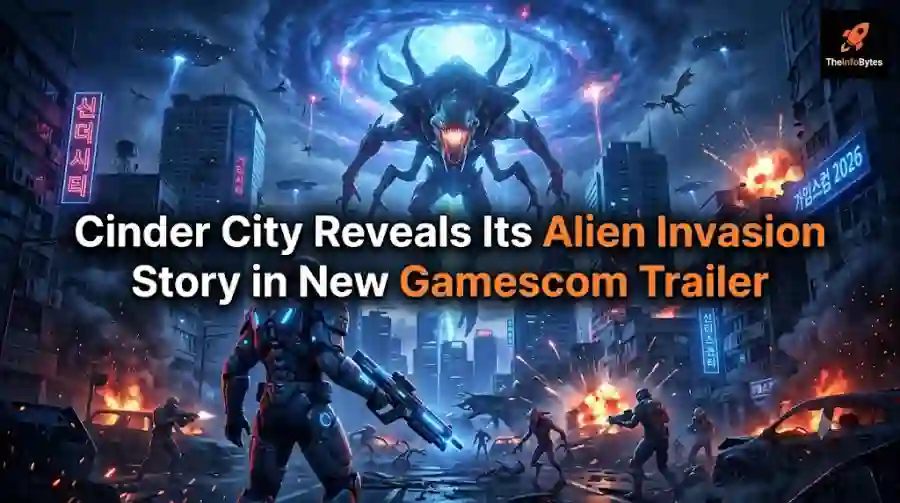
Cinder City Finally Explains the Destruction of Seoul as NCsoft Reveals Its Ambitious Open-World Shooter
NCsoft and BigFire Games have released a new story trailer for the upcoming open-world shooter, revealing that the destruction of its near-future version of Seoul was caused by a devastating alien invasion.
The revelation changes how the game's world should be understood.
Until now, Cinder City had been presented as a ruined futuristic Seoul filled with mutated creatures, criminal factions and powerful Cinderknights. However, the exact event responsible for the collapse had remained unclear.
The Gamescom Opening Night Live trailer finally provides that missing piece.
Human civilization did not simply collapse.
It was attacked.
And now the survivors are fighting to reclaim what remains.
The trailer was shown during Gamescom 2026 and provides the clearest look yet at the game's story, characters and world.
Seoul Has Been Destroyed by an Alien Invasion
The central setting of Cinder City is a devastated version of Seoul.
But this is not a completely fictional city.
The game incorporates recognizable areas and neighborhoods into its futuristic setting, including locations inspired by parts of real Seoul.
The result is a strange mixture of familiarity and science fiction.
Modern city streets have been transformed into dangerous combat zones.
Buildings have been damaged.
Creatures roam through abandoned areas.
Criminal groups have moved into the power vacuum.
And humanity is struggling to survive.
The new story trailer explains why.
An alien invasion brought the world as people knew it to an end.
That gives the setting a much stronger narrative foundation than a simple unexplained apocalypse.
The destruction was caused by an external threat, meaning the game's world is effectively the aftermath of humanity's first major encounter with an alien civilization.
Seven Is Searching for His Missing Daughter
At the center of the story is Seven, a powerful Cinderknight.
His mission is not simply to eliminate monsters or clear buildings.
He is searching for his missing daughter, Joi.
That personal objective gives the larger conflict an emotional focus.
Seven is fighting through a city devastated by an alien attack while trying to locate someone important to him.
The game's enormous conflict therefore operates on two levels.
On one level, humanity is fighting for survival.
On another, Seven is trying to find his daughter.
That combination could help Cinder City avoid becoming another shooter where the story exists only to connect one mission to the next.
The developer is instead presenting Seven's personal journey as an important part of the game's progression.
Cinderknights Are Humanity's Last Line of Defense
The Cinderknights are central to the game's world.
They are highly capable super-soldiers created to fight in the aftermath of the disaster.
Seven is one of them.
But he is not the only Cinderknight players will encounter.
The game is designed around multiple characters and interconnected stories.
This means players will experience the world from more than one perspective.
That approach could make the narrative considerably broader than a traditional single-protagonist shooter.
Instead of seeing the alien invasion and its aftermath through only Seven's eyes, players can discover how different characters are responding to the same catastrophe.
Cinder City Is Moving Away From the MMO Label
Another important detail has emerged alongside the new trailer.
Cinder City was previously described as an “MMO tactical shooter.”
That terminology is no longer being emphasized.
The current description instead positions the game as an open-world cinematic third-person shooter.
That distinction is important for potential players.
An MMO usually creates expectations around persistent online worlds, large communities, long-term progression and traditional MMO systems.
Cinder City is now being presented more heavily around cinematic shooting, open-world exploration and large-scale multiplayer PvE.
The game can still contain progression systems and online features, but its core identity is becoming clearer.
According to developer comments, the project is built around three major pillars: a tense cinematic shooter, a massive open world and large-scale multiplayer PvE.
Large-Scale PvE Is a Major Part of the Experience
Cinder City is not being built purely as a traditional single-player shooter.
The developers are also targeting large-scale multiplayer PvE.
That means players will be able to fight the game's threats alongside other players.
This could be particularly important in a world as large as Cinder City.
Instead of every street being designed exclusively around a single-player mission, large areas can potentially become combat spaces where squads fight through hostile territory together.
The multiplayer design also fits the Cinderknight concept.
These characters are supposed to represent humanity's strongest defenders.
Having multiple Cinderknights operating together makes sense both narratively and mechanically.
The World Is Designed Without Traditional Loading Screens
One of Cinder City's most technically ambitious features is its open-world architecture.
The game uses Unreal Engine 5 and its World Partition technology to stream large sections of the environment dynamically.
According to developer information, the system also supports seamless building entry without traditional loading screens.
That could have a major impact on exploration.
In many open-world games, entering a building creates a transition between the outside world and an interior level.
Cinder City is attempting to make those spaces feel more connected.
Players could move from a street into a building and continue exploring without being removed from the world.
For a game built around a dense version of Seoul, that technology could make the environment feel much more believable.
The City Is Built Around Dense Urban Exploration
Seoul gives Cinder City an interesting advantage.
The developers do not have to invent an entirely generic post-apocalyptic city.
They can work with a recognizable urban environment and then transform it.
The trailer and developer materials show a world where familiar urban spaces have become dangerous territory.
This creates opportunities for vertical exploration, interior combat and environmental storytelling.
A building can become more than scenery.
A street can become a combat arena.
A ruined district can become a mission area.
And the entire city can function as one interconnected environment.
That is the kind of structure Cinder City needs if it wants its open-world design to feel meaningful rather than simply large.
Alien Enemies Are Not the Only Threat
The alien invasion created the disaster, but players will not only be fighting alien-related creatures.
The city is also filled with mutated creatures and human factions.
Criminal groups have taken advantage of the collapse of normal society.
That creates a three-way conflict.
Players may have to deal with supernatural or alien threats while also dealing with human enemies competing for territory and resources.
This variety can help prevent combat from becoming repetitive.
A player might fight mutated creatures in one district and encounter an organized hostile faction in another.
The world can therefore tell its story through its enemies as much as through cutscenes.
Multiple Stories Could Change How Players Experience the World
Cinder City's multi-character structure is another feature worth watching.
The developers have described interconnected stories involving different Cinderknights.
That means the player may eventually understand the same events from different perspectives.
Seven's search for Joi provides the emotional foundation.
Other characters can expand the world around that central story.
This could also allow the developers to explore different parts of Seoul without forcing every narrative event through the same protagonist.
If executed properly, the system could make the city feel like a living place where different characters have their own objectives.
The Game Is Built With Unreal Engine 5
Cinder City is using Unreal Engine 5 to create its large-scale environment.
The developers are taking advantage of technologies including World Partition and Nanite to support the detailed open world.
The game also features modern NVIDIA technologies.
These include ray tracing, DLSS 4.5 with Multi Frame Generation, Ray Reconstruction and NVIDIA Reflex.
That technology focus is important because Cinder City is attempting to render a large and detailed urban environment while maintaining real-time combat.
However, there is a cost.
The game's current PC requirements are relatively demanding.
32GB of RAM Is Currently the Minimum
The current Steam requirements list 32GB of RAM as the minimum.
The minimum graphics requirement is an NVIDIA GeForce RTX 2060, while the recommended specification includes an RTX 4070.
The minimum CPU specification is an Intel Core i5-10400 or AMD Ryzen 5 3600.
The recommended processors are considerably stronger.
The developers have explained that the requirements may still decrease as optimization continues.
That means players should not necessarily treat the current requirements as the final specifications.
Still, the 32GB RAM requirement gives an indication of how demanding the game's open-world technology could be.
DLSS 4.5 Could Be Important for PC Players
Cinder City is also designed with modern upscaling and frame-generation technologies in mind.
NVIDIA's DLSS 4.5 support is particularly relevant.
The technology can help increase frame rates while allowing the game to maintain a high level of visual detail.
Ray tracing is also supported.
For players with compatible hardware, these technologies could make the difference between struggling with the game's demanding environments and achieving a smoother experience.
However, players using older PCs may need to lower graphical settings.
The Game Has Already Reached External Pre-Alpha Testing
Cinder City has already passed an important development milestone.
In August, BigFire Games conducted a limited US pre-alpha test.
The test took place across several days and was protected by a strict NDA, meaning participants were not allowed to publish footage or impressions.
This matters because it shows the project has moved beyond purely internal development.
Real players have now experienced parts of the game.
The developers can use feedback from those sessions to identify technical and gameplay problems before launch.
Additional regional tests are also planned, although specific dates and territories have not yet been announced.
There Is Still No Exact Release Date
Cinder City is currently targeting the second half of 2026.
However, there is no specific launch date yet.
The Steam page continues to list the game as coming soon.
That means players should not assume that the Gamescom trailer represents a final launch countdown.
The pre-alpha testing stage suggests that the developers still have substantial work ahead.
Optimization, balancing and additional testing will be important before the game is ready for a global release.
PlayStation 5, Xbox and PC Versions Are Planned
Cinder City is being developed for:
- PC
- PlayStation 5
- Xbox Series X|S
The game is also expected to support online multiplayer.
The developer has not announced a final price or business model yet.
That is another important piece of information players are still waiting for.
Is Cinder City Free to Play?
Not yet confirmed.
As of August 27, 2026, NCsoft and BigFire Games had not announced whether Cinder City will use a free-to-play, buy-to-play or subscription model.
The developers have said they are not planning pay-to-win elements, but the exact monetization structure remains unknown.
That is particularly important because the game has multiplayer and live-service-style features.
Players will want to know how the developers intend to support the game after launch.
The monetization model could significantly affect how the community receives it.
Why the Alien Reveal Matters
The alien invasion reveal is more important than it might initially appear.
Previously, Cinder City could have been interpreted as another post-apocalyptic shooter.
Now the setting has a clear science-fiction foundation.
Humanity was attacked by an external force.
The city is damaged because of that invasion.
The Cinderknights were created to fight back.
And Seven's personal story takes place inside that larger conflict.
This gives the developers plenty of opportunities for future storytelling.
The alien threat can remain mysterious.
The game can introduce new factions.
Different Cinderknights can reveal different parts of the conflict.
And the ruined city can gradually expose what happened during the invasion.
What Makes Cinder City Different?
The strongest selling point may be the combination of systems.
Cinder City is trying to combine:
- A recognizable version of Seoul
- Alien invasion science fiction
- Open-world exploration
- Cinematic third-person shooting
- Large-scale PvE
- Multiple playable characters
- Interconnected stories
- Seamless building exploration
- Unreal Engine 5 technology
- Online progression
That is an ambitious combination.
The challenge will be making those systems feel connected.
A huge map alone does not create a good open-world game.
Multiplayer alone does not create meaningful progression.
And cinematic storytelling does not automatically produce an engaging campaign.
Cinder City needs all of those elements to support each other.
What Players Should Watch Next
The next major information should focus on the game's release plans and testing.
Players will want to see more actual gameplay rather than cinematic footage.
The developers also need to clarify the monetization model.
Additional regional testing could provide another important milestone.
If the game is targeting the second half of 2026, those announcements should become increasingly important as launch approaches.
The PC requirements may also change as optimization continues.
Confirmed Information
The current confirmed details include:
- Cinder City received a story trailer at Gamescom Opening Night Live 2026.
- The trailer reveals that an alien invasion destroyed the game's version of Seoul.
- Seven is a Cinderknight and central character.
- Seven is searching for his missing daughter, Joi.
- The game features multiple Cinderknights.
- Their stories are interconnected.
- The game is currently described as an open-world cinematic third-person shooter.
- Large-scale multiplayer PvE is part of the design.
- Unreal Engine 5 powers the game.
- World Partition supports the open world.
- Seamless building entry is being developed.
- DLSS 4.5, ray tracing and NVIDIA Reflex are supported.
- A limited US pre-alpha test took place in August 2026.
- Additional regional testing is planned.
- PC, PS5 and Xbox Series X|S versions are planned.
- The current target is the second half of 2026.
- No exact launch date has been announced.
- The monetization model has not yet been announced.
Rumors and Speculation
The most important unknown is the game's business model.
Although the developers have indicated that pay-to-win mechanics are not planned, there is no confirmed information about whether the game will be free-to-play or premium.
The second-half 2026 launch window should also be treated as a target rather than a guaranteed date.
Until NCsoft announces a specific release day, players should expect the possibility of changes.
Conclusion
Cinder City has finally revealed the event that destroyed its version of Seoul: an alien invasion.
The new Gamescom story trailer gives the upcoming shooter a much clearer identity while introducing a personal storyline centered on Seven and his search for his missing daughter, Joi.
But the game is aiming for much more than a conventional third-person shooter.
Its enormous open world combines ruined Seoul environments with mutated creatures, hostile factions, Cinderknights and large-scale multiplayer PvE.
The developers are also pushing the technical side with Unreal Engine 5, seamless building entry and modern NVIDIA graphics technologies.
The biggest unanswered questions are now the exact release date and monetization model.
Cinder City is currently targeting the second half of 2026, but the project has only recently entered external pre-alpha testing.
That means the coming months will be crucial.
If BigFire Games can combine the game's cinematic combat, open-world exploration and multiplayer systems successfully, Cinder City could become one of the more interesting new science-fiction shooters of 2026.
For now, one thing is finally clear.
Seoul did not simply fall. It was invaded.