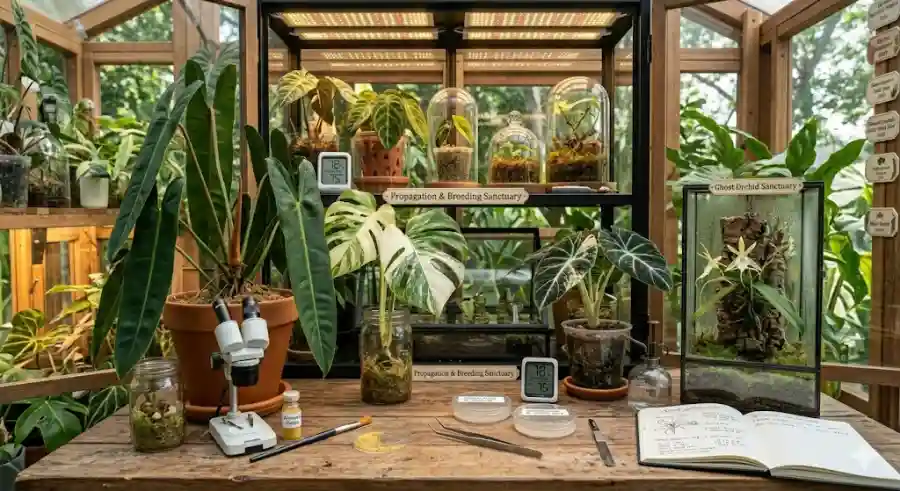
Rare Plant Breeding Explained From Spiritus Sancti to Ghost Orchid, Master the Art of Growing Botanical Rarities
From the legendary Spiritus Sancti to the elusive Ghost Orchid, this guide explores the rarest plants collectors can realistically grow at home and explains the proven methods used to breed and propagate them successfully.
Main Highlights
What You'll Learn in This Guide
- The world's most sought-after rare plants for home cultivation
- Why collectors pay premium prices for these botanical treasures
- Professional breeding techniques used by experienced growers
- How to propagate rare aroids and Alocasias successfully
- The science behind orchid seed germination
- Essential secrets for maintaining variegation
- How to build the perfect growing environment for rare species
- Expert insights into rare plant genetics and cultivation
The Crown Jewels of Rare Plant Collecting
Before learning how to breed rare plants, it helps to understand which species are considered the most desirable among collectors.
These plants combine stunning visual appeal, fascinating genetics, and extraordinary rarity, making them some of the most sought-after specimens in modern indoor gardening.
Spiritus Sancti (Philodendron spiritus-sancti)
Among aroid enthusiasts, few plants have achieved the legendary status of the Spiritus Sancti.
Often described as the "unicorn" of the philodendron world, this remarkable Brazilian species produces long, elegant, sword-shaped leaves that can grow up to two feet in length. Its dramatic silhouette instantly separates it from ordinary houseplants.
What makes this plant especially significant is its conservation status. The species is considered critically endangered in its natural habitat, meaning every cultivated specimen plays a role in preserving its genetics outside the wild.
For many years, owning a Spiritus Sancti was nearly impossible for the average collector. However, advances in tissue culture technology have gradually made the species more accessible to dedicated hobbyists. Despite improved availability, it remains a premium collector's plant and a prized centerpiece in any rare plant collection.
Why Collectors Love It
- Critically endangered species
- Long, elegant sword-like foliage
- Strong collector demand
- Exceptional visual impact
- Increasing availability through tissue culture
The True White Tiger (Monstera deliciosa variegata 'White Tiger')
Not all variegated Monsteras are created equal.
Many people mistakenly assume every white-variegated Monstera belongs to the same category, but the true White Tiger occupies a league of its own.
Unlike standard Monstera Albo varieties, the White Tiger displays highly stable, high-contrast variegation. Its leaves often feature dramatic marbling, sectoral patterns, and striking blocks of pure white coloration that resemble living works of abstract art.
This extraordinary appearance has made the White Tiger one of the most photographed and desired plants in the global collector community.
Standout Features
- Pure white marbled variegation
- Remarkably stable color patterns
- Exceptional visual contrast
- Highly desirable among collectors
- Stunning centerpiece plant
Black Velvet Albo (Alocasia reginula 'Black Velvet Albo')
Few plants demonstrate contrast quite as dramatically as the Black Velvet Albo.
The base plant already attracts attention thanks to its deep, nearly black leaves and luxurious velvety texture. Add bold white variegation into the mix, and the result becomes one of the most visually striking Alocasias available.
The challenge comes from maintaining that coloration.
Alocasia variegation is famously unpredictable. Highly variegated specimens are rare, and finding one with balanced coloration is often considered a collector's jackpot.
Why It's So Valuable
- Velvet-textured foliage
- Nearly black leaves
- Rare white variegation patterns
- Unpredictable genetics
- Strong collector demand
Ghost Orchid (Dendrophylax lindenii)
For serious growers seeking the ultimate challenge, few plants compare to the Ghost Orchid.
Unlike traditional orchids, the Ghost Orchid is leafless and epiphytic. Most of the time, it appears as a network of green roots attached to a growing surface.
Then something magical happens.
When conditions are perfect, it produces a stunning white flower that appears to float in mid-air. The bloom's ethereal appearance has fascinated botanists and orchid enthusiasts for generations.
Successfully cultivating a Ghost Orchid requires expert-level control over humidity, airflow, and environmental conditions, making it one of the most demanding projects in horticulture.
Why It Captivates Growers
- Extremely rare orchid species
- Unique leafless growth habit
- Spectacular floating blooms
- Advanced cultivation challenge
- Exceptional collector prestige
The Science Behind Rare Plant Breeding
Growing rare plants is one achievement.
Breeding them is another level entirely.
Contrary to popular belief, placing two plants next to each other won't result in successful breeding. Different species reproduce through specialized biological processes that require specific techniques and timing.
Understanding these methods is essential for expanding a collection or creating new hybrids.
Method 1: Aroid Pollination (Philodendrons and Monsteras)
Aroids use a specialized flowering structure consisting of:
- Spadix – the central flowering spike
- Spathe – the surrounding protective hood
One fascinating characteristic of aroids is that female reproductive structures mature before male structures. This evolutionary strategy helps prevent self-pollination.
Step 1: Collecting Pollen
When the flower enters its male phase, the spadix releases a sticky, golden pollen.
Using a small makeup brush, gently collect the pollen and transfer it into a clean vial.
If the intended mother plant is not yet receptive, the pollen can be frozen until needed.
Step 2: Identifying the Female Phase
The female phase occurs first.
Growers often recognize this stage when:
- The spathe opens slightly
- A subtle scent becomes noticeable
- Heat production occurs (thermogenesis)
Step 3: Pollination
Apply the collected pollen to the lower portion of the receptive spadix.
If fertilization succeeds, the spadix gradually swells and develops berries containing seeds over the following months.
Method 2: Alocasia Corm Cultivation (The Bulb Strategy)
While flowering can be used for breeding, most Alocasia collectors prefer corm propagation because it is faster, more reliable, and produces clones of the parent plant.
Corms are small bulb-like structures that develop within the root system.
Harvesting the Corms
During repotting:
- Carefully remove the plant from its container.
- Gently inspect the root system.
- Look for small teardrop-shaped corms near the base.
Germinating the Corms
After harvesting:
- Remove the dark brown outer skin carefully.
- Expose the green inner tissue.
- Position the corm upright in damp sphagnum moss or perlite.
- Seal the container to maintain near 100% humidity.
- Place under a quality grow light.
Within a few weeks, roots and new growth typically emerge, producing a miniature clone of the original plant.
Method 3: Orchid Seed Germination (Flasking)
Orchid propagation operates very differently from most houseplants.
Unlike conventional seeds, orchid seeds contain no endosperm, meaning they lack an internal food reserve to support early development.
In nature, orchids rely on specific fungi to provide nutrients during germination.
At home, growers must recreate this process using a laboratory technique known as flasking.
The Flasking Process
The method involves:
- Sterile glass flasks
- Nutrient-rich agar medium
- Controlled growing conditions
- Strict contamination prevention
The seeds are sown onto agar jelly containing sugars and nutrients.
Because orchid seeds are microscopic and highly vulnerable, even minor contamination can result in mold outbreaks that destroy an entire batch.
For this reason, professional growers often use glove boxes or laminar flow hoods to maintain absolute sterility.
The Variegation Paradox: Why Color Is So Difficult to Breed
Many collectors are drawn to plants because of their spectacular variegation.
The challenge is that variegation often behaves unpredictably.
A common misconception is that a beautifully variegated plant will automatically produce equally variegated offspring.
In reality, that is rarely the case.
The Golden Rule of Variegation
Variegation is usually a genetic mutation rather than a stable inherited trait.
Chimerical Variegation
Stability: Low to unstable
Characteristics:
- Random cellular mutation
- Chlorophyll absent in some tissues
- Common in Monstera Albo varieties
Breeding Implications:
Seeds frequently revert to solid green growth.
To preserve coloration, growers must use stem cuttings containing active variegated nodes.
Genetic or Patterned Variegation
Stability: High and predictable
Characteristics:
- Encoded directly in the plant's DNA
- Consistent patterns
- Examples include many patterned Calathea varieties
Breeding Implications:
Can often be reliably passed through seeds and plant division.
Why Monstera Albo Seeds Usually Revert
If you pollinate a Monstera Albo and grow seedlings from the resulting seeds, most offspring will emerge entirely green.
The reason is simple.
The desirable white coloration exists as a chimerical mutation rather than a stable genetic characteristic.
For collectors hoping to multiply valuable variegated specimens, nodal propagation remains the preferred method.
The Importance of the Axillary Bud
Every cutting must contain:
- An active node
- Visible variegation
- Proper placement of the axillary bud
If the growth point develops from a completely white area, the new growth lacks chlorophyll and eventually dies.
If it develops from a completely green section, the plant loses its variegation and becomes ordinary.
Maintaining the perfect balance is one of the greatest challenges in rare plant cultivation.
Building Your Own Rare Plant Laboratory
Rare plants rarely thrive on a simple windowsill.
To achieve consistent success, growers must recreate the environmental conditions these species experience in tropical rainforests and cloud forests.
Control Humidity Like a Professional
Humidity plays a crucial role in plant health.
Most rare aroids and orchids perform best between 70% and 80% humidity.
A dedicated greenhouse cabinet can provide this stability while protecting valuable specimens from household fluctuations.
Essential Equipment
- Greenhouse cabinet
- Hygrometer
- Humidifier
- Small circulation fans
Airflow is just as important as humidity.
Without movement, stagnant air encourages fungal growth and root rot.
Master Artificial Lighting
Variegated plants face a unique challenge.
Because white tissue lacks chlorophyll, these plants produce less energy through photosynthesis.
As a result, they often require brighter conditions than their all-green counterparts.
However, direct sunlight can scorch delicate white sections.
Ideal Lighting Setup
- High-quality LED grow lights
- Positioned 12–18 inches above plants
- 12–14 hours of daily illumination
- Bright but indirect exposure
Finding this balance is critical for maintaining healthy growth and strong variegation.
Create the Perfect Substrate
Heavy potting soil is one of the most common causes of failure among rare plant collectors.
Rare roots demand oxygen.
Dense, water-retentive mixes can suffocate root systems and encourage disease.
Recommended Components
- Orchid bark
- Perlite
- Pumice
- Charcoal
This chunky mixture promotes drainage while maintaining the airflow roots need to remain healthy.
Even if watering becomes slightly excessive, the root system retains access to oxygen.
Industry Impact: Why Rare Plant Collecting Continues to Grow
The rare plant market has expanded dramatically over the past decade.
Social media platforms, collector communities, and advances in tissue culture have transformed what was once a niche hobby into a global phenomenon.
Plants that were nearly impossible to obtain years ago are becoming more accessible through responsible propagation and conservation efforts.
At the same time, growing awareness of endangered species has encouraged collectors to prioritize ethically propagated plants rather than specimens taken from natural habitats.
This shift benefits both hobbyists and conservation initiatives.
Why Rare Plant Breeding Matters
Breeding rare plants goes far beyond creating beautiful collections.
It contributes to:
- Genetic preservation
- Conservation awareness
- Sustainable propagation
- Botanical education
- Reduced pressure on wild populations
Every successful propagation project helps ensure that rare genetics remain available for future generations of growers and researchers.